
DOT SAP Program in North Carolina 2026: Complete Guide for CDL Drivers

For commercial drivers, maintaining compliance with the U.S. Department of Transportation (DOT) drug and alcohol regulations is a critical part of staying on the road. A failed DOT drug or alcohol test, refusal to test, or another qualifying violation can immediately remove a Commercial Driver’s License (CDL) holder from performing safety-sensitive duties. Returning to work requires completing the DOT SAP Program in North Carolina and following the federally mandated return-to-duty process. Many drivers assume that completing a treatment program alone is enough to regain eligibility. In reality, the process involves several required steps established by the DOT and administered through qualified Substance Abuse Professionals (SAPs). Employers, owner-operators, and CDL holders must all follow these federal regulations before a driver can legally resume safety-sensitive work. This guide explains how the DOT SAP Program in North Carolina works in 2026, who needs it, what to expect during each stage of the process, estimated costs, and how to choose a qualified SAP provider. What Is the DOT SAP Program in North Carolina? The DOT SAP Program in North Carolina is a federally regulated evaluation and education process for employees who violate DOT drug and alcohol testing regulations. The program is not unique to North Carolina. Instead, it follows nationwide standards established under 49 CFR Part 40, which outlines procedures for workplace drug and alcohol testing in transportation industries. A Substance Abuse Professional, commonly called a SAP, is responsible for evaluating the employee, determining the appropriate education or treatment plan, monitoring progress, and deciding whether the individual has successfully completed the recommended requirements. The SAP does not decide whether an employer should rehire a driver. Their responsibility is to determine whether the employee has complied with the required recommendations before becoming eligible for the return-to-duty testing process. The program applies to safety-sensitive transportation employees regulated by agencies including: Federal Motor Carrier Safety Administration (FMCSA) Federal Aviation Administration (FAA) Federal Railroad Administration (FRA) Federal Transit Administration (FTA) Pipeline and Hazardous Materials Safety Administration (PHMSA) United States Coast Guard (USCG) For CDL drivers, the FMCSA regulations are the most relevant because they govern commercial trucking operations. Who Needs the DOT SAP Program? A driver must complete the DOT SAP Program after committing a DOT drug or alcohol regulation violation. These violations include: Positive DOT drug test Alcohol test result of 0.04 or higher Refusal to take a required DOT drug or alcohol test Adulterated or substituted drug test specimen Possession or use of prohibited drugs while performing safety-sensitive duties Violating DOT alcohol misuse regulations The Clearinghouse, managed by the FMCSA, records these violations for CDL drivers. Until the return-to-duty process is completed, employers cannot legally permit affected drivers to perform safety-sensitive functions. Failed a DOT Drug Test in North Carolina? Receiving notice of a failed DOT drug test can be stressful, but understanding the required process can help drivers move forward. A positive test does not permanently end a CDL career. Federal regulations provide a structured pathway for eligible drivers to demonstrate compliance and eventually return to safety-sensitive work. After a verified positive test, employers must immediately remove the employee from safety-sensitive duties. For CDL drivers, the violation is also reported to the FMCSA Drug and Alcohol Clearinghouse. The next step is contacting a qualified Substance Abuse Professional. Avoid delaying the evaluation. Waiting weeks or months can significantly postpone the return-to-duty process because treatment recommendations cannot begin until after the initial SAP assessment. What Happens After a Positive DOT Drug Test in North Carolina? Every DOT-regulated employer must follow the federal return-to-duty process after a qualifying drug or alcohol violation. The process generally follows these stages. Step What Happens Responsible Party 1 Driver removed from safety-sensitive duties Employer 2 Initial SAP evaluation Qualified SAP 3 Education or treatment recommendation SAP 4 Completion of recommendations Driver 5 Follow-up SAP evaluation SAP 6 Return-to-duty drug or alcohol test Employer and testing facility 7 Follow-up testing plan Employer based on SAP recommendations Skipping any of these steps prevents a driver from legally returning to DOT-regulated work. Understanding the Initial SAP Evaluation The initial SAP evaluation is one of the most important parts of the process. During the assessment, the SAP reviews several factors, including: Details surrounding the DOT violation Drug or alcohol use history Medical and behavioral health information Employment background Previous treatment history Risk factors that may affect future compliance The purpose is not to punish the driver but to determine an appropriate course of action based on professional clinical judgment. Depending on the assessment, recommendations may include: Drug education classes Alcohol awareness education Individual counseling Outpatient treatment Intensive outpatient treatment Residential treatment when clinically appropriate No two recommendations are necessarily the same because each case is evaluated individually. Completing Education or Treatment Requirements After the evaluation, drivers must successfully complete every recommendation made by the SAP. This could involve attending educational sessions, completing counseling, participating in outpatient treatment, or meeting other clinically appropriate requirements. Completion does not automatically restore eligibility. Drivers must provide documentation showing that all recommendations have been fulfilled before scheduling the follow-up evaluation. The length of this phase varies depending on the recommendation. Some education programs may be completed within days, while structured treatment programs can take several weeks or longer. Follow-Up SAP Evaluation Once all recommendations have been completed, the driver returns to the same SAP for a follow-up evaluation. During this appointment, the SAP determines whether the employee has: Successfully completed the required education or treatment Demonstrated compliance with recommendations Shown readiness to return to safety-sensitive duties If satisfied, the SAP reports successful compliance and authorizes the employee to move forward in the DOT return-to-duty process. If additional work is necessary, further education or treatment may be recommended before successful completion is granted. Return-to-Duty Testing A successful follow-up evaluation does not immediately place a driver back behind the wheel. The employer must arrange a directly observed return-to-duty drug or alcohol test. The driver must receive a negative test result before resuming safety-sensitive responsibilities. Following reinstatement, the SAP also develops a follow-up
DOT SAP Program in Florida 2026: Complete Guide for Truck Drivers

Understanding the DOT SAP Program in Florida The DOT SAP Program in Florida is a federally mandated return-to-duty process required for commercial drivers who violate drug and alcohol testing rules under the U.S. Department of Transportation regulations. It applies to all CDL holders regulated by the Federal Motor Carrier Safety Administration (FMCSA). When a driver fails, refuses, or otherwise violates a DOT drug or alcohol test, they are immediately removed from safety-sensitive duties and placed in a “prohibited” status in the FMCSA Clearinghouse. This means they cannot legally operate a commercial motor vehicle until they complete the full SAP process. Florida has a large commercial transportation industry due to its ports, interstate freight routes, agriculture distribution, and tourism logistics. Because of this, compliance enforcement is strict, and employers regularly check Clearinghouse records before hiring or retaining drivers. This guide explains the DOT SAP Program in Florida, step-by-step requirements, timelines, costs, challenges, and how drivers can return to duty efficiently in 2026. What Is the DOT SAP Program in Florida? The DOT SAP Program in Florida is governed under 49 CFR Part 40, which outlines the federal rules for drug and alcohol testing in safety-sensitive transportation jobs. A Substance Abuse Professional (SAP) is a DOT-qualified evaluator who determines whether a driver is eligible to return to duty after a violation. According to FMCSA regulations: A CDL driver must complete the SAP process if they: Fail a DOT drug or alcohol test Refuse a required DOT test Violate DOT testing policies in any form Once this occurs, the driver cannot return to work until all SAP requirements are completed and verified in the FMCSA Clearinghouse. The SAP process is not optional and applies nationwide, including Florida. Why the DOT SAP Program in Florida Is Strictly Enforced Florida is one of the busiest freight states in the United States due to: Port of Miami Port Tampa Bay Jacksonville logistics hubs Interstate highways like I-95 and I-75 Because of this, FMCSA compliance enforcement is taken seriously to maintain road safety and industry standards. Once a violation occurs: The driver is marked “prohibited” in the Clearinghouse Employers are legally required to remove the driver from duty Future employers can view the violation record The Florida Department of Highway Safety and Motor Vehicles (FLHSMV) also aligns CDL enforcement with FMCSA regulations. Step-by-Step DOT SAP Program in Florida Process The DOT SAP Program in Florida follows a strict federal sequence. Each step must be completed before moving to the next. Step 1: SAP Initial Evaluation The process begins with a face-to-face or virtual evaluation by a qualified SAP. The SAP will: Review the DOT violation Assess substance use history Evaluate risk level Determine treatment or education needs This step is mandatory before any further action can take place. Step 2: Education or Treatment Program Based on the evaluation, the SAP may recommend: Drug and alcohol education classes Outpatient counseling Intensive outpatient programs (IOP) Residential treatment in severe cases The type of program depends on the severity of the violation and clinical assessment. Federal regulations require full completion of this recommendation before moving forward. Step 3: Follow-Up SAP Evaluation After completing the assigned program, the driver returns to the SAP for reassessment. The SAP reviews: Completion certificates Attendance records Compliance behavior Treatment progress reports If satisfactory, the SAP authorizes the driver to proceed to return-to-duty testing. Step 4: Return-to-Duty (RTD) Test The driver must complete a directly observed DOT drug or alcohol test. Key points: It must be negative It is performed under strict supervision It is required for Clearinghouse update Without a negative result, the process cannot continue. Step 5: Follow-Up Testing Plan After returning to work, the driver enters a follow-up testing program. This includes: Random drug/alcohol testing SAP-determined frequency Monitoring period up to 5 years This ensures long-term compliance and safety. DOT SAP Program in Florida Overview (2026) Stage Requirement Outcome Violation Occurs Failed or refused test Driver marked prohibited SAP Evaluation Clinical assessment Treatment plan assigned Education/Treatment Required program completion Eligibility for next step Follow-Up Evaluation SAP review RTD approval RTD Test Negative drug/alcohol test Return-to-duty allowed Monitoring Random testing Long-term compliance Read More: DOT SAP Program in New York 2026: Complete Guide for CDL Drivers How Long Does the DOT SAP Program in Florida Take? There is no fixed timeline for the DOT SAP Program in Florida because it depends on several factors: Type of violation SAP recommendation Treatment duration Scheduling availability Driver responsiveness Typical timelines: Education-only cases: a few days to 2 weeks Moderate cases: 2 to 6 weeks Intensive treatment cases: several weeks or longer FMCSA rules require full completion of all SAP recommendations before return-to-duty clearance is granted. Cost of the DOT SAP Program in Florida The cost of completing the SAP process varies depending on: SAP evaluation fees Education program costs Treatment program intensity Follow-up evaluation fees Industry estimates show total costs generally range from $400 to $1,500+ depending on complexity and treatment needs. Drivers should also consider indirect costs such as lost income during downtime. Common Challenges in the Florida SAP Process Many drivers experience delays due to: Difficulty scheduling SAP evaluation Misunderstanding FMCSA requirements Missing documentation Delayed treatment enrollment Poor communication between providers Even small errors can extend the DOT SAP Program in Florida timeline significantly. How to Complete the DOT SAP Program in Florida Faster While the process is regulated, efficiency depends on execution. Key factors that reduce delays: Early SAP scheduling Choosing DOT-qualified SAP providers Completing treatment without gaps Proper documentation handling Fast Clearinghouse updates Speed is not about skipping steps but completing them without administrative delays. Comparison of SAP Program Providers in Florida Provider Service Type Speed of Process Cost Transparency Virtual Options American River Wellness SAP evaluation and counseling Moderate Medium Limited AACS Counseling DOT SAP program services Fast-track options advertised Medium Yes Resilient Return SAP and return-to-duty support Moderate to fast Medium Yes SAPvaluate Structured SAP coordination and guidance Streamlined scheduling focus Transparent approach Yes This comparison reflects general service positioning
DOT SAP Program in Georgia 2026: Complete Guide for CDL Drivers

Understanding the DOT SAP Program in Georgia The DOT SAP Program in Georgia is a federally regulated return-to-duty process required for commercial drivers who violate drug or alcohol testing rules under the U.S. Department of Transportation framework. It is not optional, and it applies to every CDL holder placed in “prohibited” status in the FMCSA Clearinghouse. In Georgia, enforcement has become stricter due to automated Clearinghouse reporting that directly impacts CDL status. Once a violation is recorded, drivers are immediately removed from safety-sensitive duties and cannot legally operate a commercial motor vehicle until completing the full SAP process. The purpose of this guide is to explain how the DOT SAP Program in Georgia works in 2026, what steps CDL drivers must follow, how long the process may take, and what factors affect return-to-duty eligibility. What Is the DOT SAP Program in Georgia? The DOT SAP Program in Georgia is governed by 49 CFR Part 40, a federal regulation that outlines procedures for workplace drug and alcohol testing in safety-sensitive industries. According to federal rules, any CDL driver who: Tests positive for drugs or alcohol Refuses a DOT drug/alcohol test Violates DOT testing policy in any way must complete a structured SAP evaluation before returning to work. The SAP (Substance Abuse Professional) is a DOT-qualified evaluator who determines: The severity of the violation Required education or treatment Readiness to return to duty Follow-up testing requirements This makes the DOT SAP Program in Georgia a compliance-driven recovery process rather than a medical treatment program alone. Why CDL Drivers in Georgia Must Complete SAP Evaluation In Georgia, CDL drivers are regulated under FMCSA Clearinghouse rules. Once a violation occurs: CDL status is marked “Prohibited” Drivers are removed from safety-sensitive duties immediately Employers cannot allow driving until SAP clearance is complete The Georgia Department of Driver Services also enforces automatic CDL downgrade rules after Clearinghouse violations, meaning drivers may lose commercial driving privileges until they complete the return-to-duty process . This system ensures that only compliant and cleared drivers are operating commercial vehicles on Georgia roads. Step-by-Step DOT SAP Program in Georgia Process (2026) The DOT SAP Program in Georgia follows a structured federal process that must be completed in sequence. 1. SAP Initial Evaluation The first step is a clinical assessment by a DOT-qualified SAP. This evaluation reviews: Violation details Substance use history Risk factors Job safety considerations Based on this, the SAP creates a personalized plan. 2. Education or Treatment Program The SAP may recommend: Drug and alcohol education classes Outpatient counseling Intensive outpatient treatment (IOP) Residential treatment in severe cases Federal guidelines require full completion of these recommendations before moving forward . 3. Follow-Up SAP Evaluation After completing the program, the SAP reviews: Attendance records Completion certificates Treatment compliance If satisfactory, the SAP issues eligibility for return-to-duty testing. 4. Return-to-Duty (RTD) Drug or Alcohol Test Drivers must pass a directly observed RTD test. A negative result is required to proceed. 5. Follow-Up Testing Plan After returning to work, drivers are placed under a follow-up testing schedule that can last up to five years, with unannounced testing requirements defined by the SAP. Read Also: DOT SAP Program in New York 2026: Complete Guide for CDL Drivers DOT SAP Program in Georgia Overview (2026) Step Requirement Outcome Violation Reported Positive test or refusal Immediate removal from duty Initial SAP Evaluation Clinical assessment Treatment plan assigned Education or Treatment SAP-recommended program Must be fully completed Follow-Up Evaluation SAP review of progress RTD clearance eligibility RTD Test Observed drug/alcohol test Must be negative Follow-Up Testing Random testing schedule Long-term compliance monitoring How Long Does the DOT SAP Program in Georgia Take? The timeline for the DOT SAP Program in Georgia depends on: Severity of the violation Type of treatment required Speed of completion SAP scheduling availability In general: Education-only cases may take a few days to a few weeks Treatment-based cases may take several weeks or longer Federal rules require completion of every SAP recommendation before return-to-duty clearance is granted . Common Challenges CDL Drivers Face in Georgia Many drivers encounter delays in the DOT SAP Program in Georgia due to: Misunderstanding SAP requirements Delayed enrollment in treatment programs Missing documentation Incorrect SAP selection Waiting for follow-up evaluations Since federal regulations are strict, even small mistakes can extend the timeline significantly. What CDL Drivers Should Know Before Starting SAP in Georgia Before beginning the DOT SAP Program in Georgia, drivers should understand: Employers cannot bypass SAP requirements Clearinghouse status controls driving eligibility Every step must be documented Only DOT-qualified SAPs can clear violations There are no shortcuts in the federal return-to-duty process. The Role of Compliance in Returning to Work The SAP process is designed to ensure safety on public roads. According to federal DOT regulations, no driver can resume safety-sensitive duties until all SAP requirements are completed and verified. This includes: Successful SAP clearance Negative RTD test Employer confirmation in Clearinghouse How SAPvaluate Helps CDL Drivers Complete the DOT SAP Program in Georgia Faster and More Affordably For many CDL drivers in Georgia, the biggest challenge after a DOT violation is not just completing the process, but doing it quickly without losing weeks or months of income. The DOT SAP Program in Georgia is federally regulated under 49 CFR Part 40, which means every step must be completed correctly. However, the timeline can vary significantly depending on how efficiently the process is handled. In real-world DOT compliance cases, industry data shows that completion time can range from a few days to several weeks depending on SAP availability, treatment requirements, and follow-up scheduling . This is where structured coordination and faster scheduling can make a meaningful difference. Faster SAP Scheduling and Reduced Waiting Time One of the most common delays in the DOT SAP Program in Georgia is waiting for the initial SAP evaluation appointment. Some drivers lose several days simply due to scheduling backlogs. SAPvaluate focuses on reducing this delay by offering streamlined scheduling for DOT-qualified SAP evaluations. According to provider service data,
DOT SAP Program in California 2026: Complete Guide for CDL Drivers
The DOT SAP Program in California 2026 is a federally regulated return-to-duty process required for any commercial driver who violates U.S. Department of Transportation drug and alcohol testing rules. It applies to all CDL holders operating under FMCSA authority, regardless of employer or experience level. Once a violation occurs, a driver cannot legally return to safety-sensitive duties until they complete the Substance Abuse Professional (SAP) process and pass a Return-to-Duty test. This requirement is enforced through the FMCSA Drug and Alcohol Clearinghouse, which tracks violations nationwide and prevents unauthorized driving activity. Unlike informal rehabilitation programs, the DOT SAP Program in California 2026 is structured, mandatory, and governed by federal law under 49 CFR Part 40. The process is designed not only to address compliance but also to ensure long-term safety in commercial transportation. What Is the DOT SAP Program in California 2026? The DOT SAP Program in California 2026 is a federally mandated evaluation and treatment pathway required after a DOT drug or alcohol violation. It is not optional, and no employer, carrier, or state agency can bypass it. Under FMCSA regulations, a Substance Abuse Professional (SAP) is the only authorized professional who can determine whether a driver is fit to return to safety-sensitive work after a violation. Once a driver enters the program, they are immediately classified as “prohibited” in the FMCSA Clearinghouse, meaning they are legally restricted from operating commercial vehicles until the SAP process is fully completed and a negative Return-to-Duty test is recorded. This structure ensures standardized enforcement across all U.S. states, including California, without variation in interpretation or employer discretion. FMCSA Regulations Behind the SAP Program The DOT SAP Program in California 2026 operates under strict federal guidelines defined by: 49 CFR Part 40 (Procedures for Transportation Workplace Drug and Alcohol Testing Programs) FMCSA Drug and Alcohol Clearinghouse Rules U.S. Department of Transportation (DOT) workplace safety standards These regulations establish a uniform process across the United States, meaning California drivers follow the same SAP structure as drivers in Texas, Florida, or any other state. According to FMCSA guidance, the SAP’s role is strictly evaluative and corrective, not disciplinary. The SAP determines education or treatment needs and evaluates readiness for return-to-duty clearance, but does not act as an employer or advocate. Who Is Required to Complete the DOT SAP Program in California 2026? A CDL driver must enter the DOT SAP Program in California 2026 if they commit any DOT-defined violation, including: A positive drug test result under DOT testing standards An alcohol test result of 0.04 BAC or higher Refusal to submit to a required DOT test Tampering with or attempting to alter test results Any violation reported to the FMCSA Clearinghouse Once any of these occur, the driver is immediately removed from safety-sensitive functions. The employer is legally required to report the violation to the Clearinghouse, which then restricts driving eligibility until SAP completion. Read More: I Failed My DOT Drug Test — Now What? Step-by-Step DOT SAP Program in California 2026 Process The DOT SAP Program in California 2026 follows a structured federal sequence. Each stage must be completed in order, and no steps can be skipped. Step 1: Violation Reporting and Removal from Duty Once a violation is confirmed, the employer removes the driver from all safety-sensitive duties and reports the violation to the FMCSA Clearinghouse. Step 2: SAP Evaluation The driver must select a DOT-qualified SAP who conducts a formal clinical assessment. This includes reviewing substance use history, workplace context, and risk factors affecting safety-sensitive performance. Step 3: Recommended Education or Treatment Based on evaluation findings, the SAP assigns a structured plan. This may include education classes, counseling sessions, or treatment programs depending on severity and clinical judgment. Step 4: Completion and Compliance Verification The driver must complete all SAP-recommended steps. Documentation is required to confirm compliance before moving forward. Step 5: Follow-Up SAP Evaluation The SAP conducts a second evaluation to confirm readiness for return-to-duty testing. Approval is required before the driver can proceed. Step 6: Return-to-Duty (RTD) Test The driver must pass a directly observed DOT drug and/or alcohol test. A negative result is required to regain eligibility. Step 7: Follow-Up Testing Program After reinstatement, the SAP assigns a follow-up testing schedule that may last up to 5 years, including unannounced testing. Read More: Understanding the DOT Return-To-Duty Process: A Comprehensive Guide for Drivers What Happens During a SAP Evaluation? The SAP evaluation is the most critical stage of the DOT SAP Program in California 2026. During this session, the SAP conducts a structured clinical interview designed to assess: Substance use history and patterns Circumstances surrounding the DOT violation Risk level for future safety-sensitive work Compliance readiness and behavioral indicators The SAP then determines whether the driver requires education, counseling, or treatment. This decision is not optional and must be followed exactly as prescribed. Once completed, the SAP documents progress and determines eligibility for the follow-up evaluation. Read More: Return to Duty SAP Evaluation Explained DOT SAP Program in California 2026 Full Process Breakdown Stage Description FMCSA Outcome Violation Occurs Positive test or refusal reported Driver removed from duty Clearinghouse Entry Employer reports violation “Prohibited” status applied SAP Evaluation Clinical assessment conducted Treatment plan assigned Program Completion Education or treatment completed Compliance verified Follow-up Evaluation SAP reviews progress RTD eligibility granted RTD Test Negative DOT test required Return-to-duty approved Follow-up Testing Ongoing monitoring (up to 5 years) Continued compliance enforcement Timeline of the DOT SAP Program in California 2026 The timeline for the DOT SAP Program in California 2026 varies based on individual circumstances and SAP recommendations. In general, timelines depend on: Severity of violation Required education or treatment duration Appointment availability with SAP providers Speed of program completion by the driver Some drivers may complete the process in a few weeks if only education is required. Others may take several months if treatment programs or extended monitoring are necessary. Federal regulations do not set a fixed duration, but they do require full compliance before RTD approval. Importance
DOT SAP Program in New York 2026: Complete Guide for CDL Drivers

The DOT SAP Program in New York is an essential federal requirement for CDL drivers and safety-sensitive transportation employees who violate Department of Transportation drug and alcohol regulations. In 2026, enforcement surrounding the FMCSA Drug and Alcohol Clearinghouse continues to increase, making compliance more important than ever for commercial drivers across New York. A failed drug test, alcohol violation, or refusal to test can immediately remove a driver from safety-sensitive duties. Before returning to work, the individual must complete the federally mandated SAP return-to-duty process. This guide explains how the DOT SAP Program in New York 2026 works, who needs it, what the process involves, and what drivers should know about compliance requirements under federal law. What Is the DOT SAP Program? The DOT SAP Program is a federally regulated process established under DOT regulation 49 CFR Part 40. It applies to safety-sensitive transportation employees who violate DOT drug and alcohol testing rules. SAP stands for Substance Abuse Professional. A SAP is responsible for evaluating employees after a violation and determining what education, counseling, treatment, or follow-up measures are required before the employee can return to safety-sensitive work. The program exists to support transportation safety and ensure that employees meet federal compliance standards before resuming regulated duties. The DOT SAP Program applies to employees regulated by: Federal Motor Carrier Safety Administration (FMCSA) Federal Aviation Administration (FAA) Federal Railroad Administration (FRA) Federal Transit Administration (FTA) Pipeline and Hazardous Materials Safety Administration (PHMSA) United States Coast Guard (USCG) Who Needs the DOT SAP Program in New York? Drivers and safety-sensitive employees in New York may be required to complete the DOT SAP Program if they: Test positive on a DOT drug test Receive an alcohol test result of 0.04 or greater Refuse a required DOT drug or alcohol test Submit an adulterated or substituted specimen Fail to appear for testing Leave a testing site before completion Commit another DOT testing violation Once a violation occurs, the employee must immediately stop performing safety-sensitive functions until the entire return-to-duty process is completed. This applies to CDL drivers throughout New York, including New York City, Buffalo, Rochester, Syracuse, Albany, Yonkers, and surrounding areas. DOT SAP Program in New York 2026: Process Overview Step What Happens Key Requirement Estimated Timeline 1. DOT Violation Occurs Employee receives a positive drug test, alcohol violation, or refusal to test Immediate removal from safety-sensitive duties Same day 2. SAP Evaluation Driver completes an assessment with a DOT-qualified Substance Abuse Professional Evaluation under 49 CFR Part 40 regulations 1 to 3 days 3. Education or Treatment Employee completes SAP-recommended education, counseling, or treatment Full completion of all recommendations Varies by case 4. Follow-Up Evaluation SAP reviews compliance and determines eligibility for return-to-duty testing Successful completion of recommendations 1 to 7 days 5. Return-to-Duty Test Driver takes a directly observed DOT drug and/or alcohol test Negative test result required Usually within a few days 6. Return to Work Employer may reinstate employee into safety-sensitive duties Employer approval and Clearinghouse compliance Depends on employer 7. Follow-Up Testing Program Employee enters ongoing random follow-up testing schedule Minimum of 6 tests in 12 months Up to 5 years Understanding the FMCSA Clearinghouse in 2026 The FMCSA Drug and Alcohol Clearinghouse remains one of the most important parts of the DOT SAP Program in New York. The Clearinghouse is a national online database that stores: DOT drug and alcohol violations Return-to-duty testing records SAP progress updates Employer compliance information When a CDL driver receives a violation, the information is entered into the Clearinghouse system. Employers can review these records before hiring or allowing a driver to operate a commercial vehicle. SAP professionals are also required to report specific stages of the return-to-duty process into the Clearinghouse database. As federal oversight continues to strengthen in 2026, maintaining compliance with Clearinghouse requirements is critical for drivers seeking to return to work. Step-by-Step Breakdown of the DOT SAP Program 1. Immediate Removal from Safety-Sensitive Duties Federal regulations require employers to immediately remove an employee from safety-sensitive duties after a qualifying DOT violation. For CDL drivers, this means they cannot legally operate a commercial vehicle until they complete the return-to-duty process. 2. Initial SAP Evaluation The driver must schedule an evaluation with a DOT-qualified Substance Abuse Professional. During the assessment, the SAP evaluates: Substance use history Circumstances of the violation Behavioral factors Employment background Potential safety risks Recovery needs The purpose is to determine the appropriate level of education or treatment needed before the employee may proceed. 3. Completion of Education or Treatment Following the evaluation, the SAP creates a customized recommendation plan. Recommendations may include: Drug and alcohol education courses Individual counseling Outpatient treatment Intensive treatment programs Recovery support services Federal regulations require full completion of all recommendations. The employee cannot move forward until the SAP confirms compliance. 4. Follow-Up SAP Evaluation Once treatment or education is completed, the employee attends a follow-up evaluation with the SAP. During this stage, the SAP determines whether the employee has successfully complied with all requirements and is ready for return-to-duty testing. If approved, the SAP reports the compliance status in the Clearinghouse. 5. Return-to-Duty Testing The employee must complete a DOT return-to-duty drug and/or alcohol test. For drug testing, federal law requires directly observed specimen collection. A negative test result is mandatory before an employer may allow the employee to resume safety-sensitive work. 6. Follow-Up Testing Program After returning to duty, the employee enters a follow-up testing program determined by the SAP. Federal regulations require at least six unannounced follow-up tests during the first 12 months. Depending on the circumstances, follow-up testing may continue for up to five years. The purpose is to monitor continued compliance and workplace safety. DOT SAP Program in New York 2026: Key Compliance Facts Requirement Details Governing Regulation DOT 49 CFR Part 40 Applies To CDL drivers and safety-sensitive transportation employees Main Oversight Agency FMCSA Clearinghouse Reporting Required Yes Online SAP Evaluations Available Yes, through qualified providers Return-to-Duty Drug Test Must be directly observed Minimum Follow-Up
Return to Duty SAP Evaluation Explained

What Is a Return to Duty SAP Evaluation and Why Does It Exist? When a safety-sensitive transportation worker tests positive on a DOT-mandated drug or alcohol screen, or refuses to take one, federal law stops them from performing their job immediately. The only pathway back is a structured process that starts with a face-to-face assessment by a qualified Substance Abuse Professional (SAP). That assessment is called the Return to Duty SAP Evaluation. The Department of Transportation formalized this requirement through the Omnibus Transportation Employee Testing Act of 1991 and later codified the full process in 49 CFR Part 40, Subpart O. The DOT describes the Substance Abuse Professional as the “gatekeeper” to the return-to-duty process because no safety-sensitive employee can move forward without SAP approval. This article explains the complete process, from violation through follow-up testing, and outlines what employees, employers, and CDL holders should expect. Key Regulatory Reference: 49 CFR Part 40, Subpart O governs SAP qualifications, evaluations, and follow-up testing requirements across all DOT-regulated industries. Who Needs a Return to Duty SAP Evaluation? Any employee in a DOT-regulated safety-sensitive position who commits a drug or alcohol violation must complete the return-to-duty process before resuming those duties. Common triggers include: Verified positive DOT drug test DOT alcohol test of 0.04 or higher Refusal to test Adulterated or substituted specimen Other violations of DOT drug and alcohol regulations Covered positions include: CDL drivers Pilots and flight crew Aircraft mechanics Railroad workers Transit employees Pipeline operators Maritime workers One important fact: state marijuana laws do not override federal DOT regulations. A positive marijuana test triggers the same return-to-duty process as any other prohibited substance. Clearinghouse Fact (January 2026): More than 200,000 CDL holders remain in prohibited status within the FMCSA Drug and Alcohol Clearinghouse. Immediate Consequences of a Violation Upon a DOT drug or alcohol violation: The employee is immediately removed from safety-sensitive duties. The employer must prevent the employee from performing covered work. The employee enters prohibited status. CDL downgrade procedures may begin under Clearinghouse regulations. The employer must provide a list of qualified SAPs. The SAP process generally costs the employee between $400–$500 for evaluations, plus testing and treatment costs if required. What Makes Someone a Qualified Substance Abuse Professional? A qualified SAP must meet federal credentialing requirements. Required Professional Credentials A SAP may be: Licensed physician (MD or DO) Licensed social worker Licensed psychologist Certified Employee Assistance Professional Certified drug and alcohol counselor In addition, SAPs must: Complete DOT-specific qualification training Pass a qualifying examination Maintain continuing education requirements What the SAP Is Evaluating The SAP evaluates: Substance use history Circumstances of the violation Prior treatment history Mental health considerations Readiness for treatment and recovery The SAP acts as an independent evaluator focused on public safety. Important: A SAP evaluation is not simply a compliance formality. It is a clinical assessment that determines what treatment or education must occur before returning to work. The Return to Duty Process: Step by Step Step 1: Initial SAP Evaluation The employee schedules an evaluation with a qualified SAP. Topics reviewed include: Violation details Substance use history Previous treatment Clinical assessment findings Evaluations may be conducted in person or remotely via secure video technology. What Happens During a Return to Duty SAP Evaluation? One of the most common questions drivers ask is what actually happens during a Return to Duty SAP Evaluation. While every case is unique, the evaluation is generally a structured clinical interview designed to help the Substance Abuse Professional understand the circumstances surrounding the violation and determine what level of education or treatment is appropriate. Most initial evaluations last between 60 and 90 minutes, though some may be shorter or longer depending on the complexity of the case. During the meeting, the SAP typically reviews the DOT violation, discusses the employee’s substance use history, examines any previous treatment or counseling experiences, and asks questions about work history, family support systems, and overall functioning. The SAP may also use standardized screening tools or questionnaires as part of the assessment process. These tools help evaluate patterns of alcohol or drug use and identify factors that may increase the risk of future violations. Many employees worry that the evaluation is designed to catch them off guard or punish them. In reality, the SAP’s role is to conduct an objective clinical assessment and determine what steps are necessary to support both public safety and regulatory compliance. How to Prepare for a Return to Duty SAP Evaluation Preparing properly for a Return to Duty SAP Evaluation can help the process move more efficiently and reduce delays. Before your appointment, gather any documents that may be relevant to your case, including employer paperwork related to the violation, previous treatment records, prescription medication information, and identification documents. While not every SAP requires the same materials, having these records available can make it easier to verify important details. It is also important to be honest during the evaluation. The SAP’s recommendations are based on the information available at the time of the assessment. Providing incomplete or inaccurate information can complicate the process and may lead to additional questions later. Employees should also set aside enough uninterrupted time for the evaluation and ensure they have a private location if the assessment is being conducted virtually. Step 2: Education or Treatment The SAP develops a personalized plan. This may involve: Drug and alcohol education Counseling Outpatient treatment Intensive outpatient treatment Inpatient rehabilitation The employee must complete all recommendations. Does Everyone Get Sent to Rehab? No. One of the biggest misconceptions about the Return to Duty SAP Evaluation process is that every employee will be required to attend inpatient rehabilitation or an intensive treatment program. DOT regulations require SAPs to make individualized recommendations based on the employee’s circumstances, substance use history, and clinical assessment findings. Some employees may only be required to complete a structured drug and alcohol education program. Others may benefit from outpatient counseling or relapse-prevention services. More intensive treatment recommendations are generally reserved for situations where
CDL Downgrades in 2026: How a Clearinghouse Prohibited Status Triggers Immediate SDLA Action
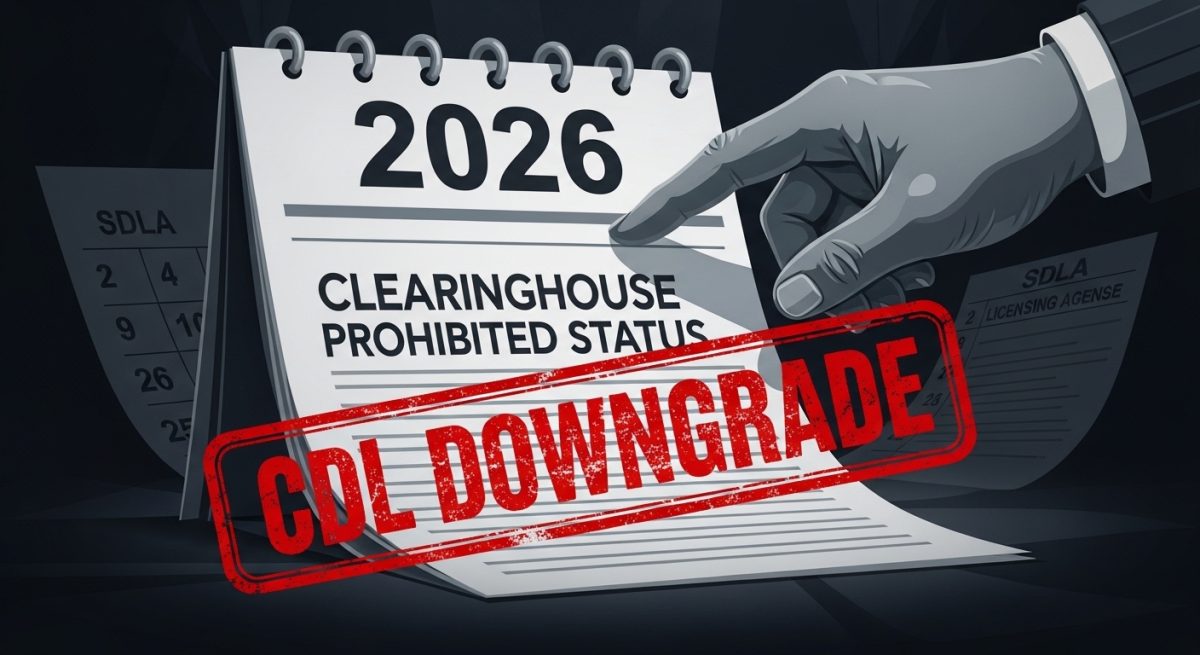
If you hold a Commercial Driver’s License (CDL) and have a drug or alcohol program violation in the FMCSA Drug and Alcohol Clearinghouse, your driving privileges are at risk. As of November 18, 2024, State Driver Licensing Agencies (SDLAs) are federally required to remove commercial driving privileges from any CDL or CLP holder who has a prohibited status in the Clearinghouse. This is not a warning or a notice. This is an automatic CDL downgrade process that is now the law across all 50 states. The Federal Motor Carrier Safety Administration (FMCSA) finalized the Clearinghouse II rule (86 FR 55718) back in October 2021, giving states three years to prepare for compliance. That compliance date has now passed. For any CDL driver with an unresolved violation sitting in the Clearinghouse, the consequences are immediate and real. Your state DMV or equivalent licensing authority will be notified, and within 60 days, your commercial driving privileges can be stripped. This article explains exactly how the CDL downgrade process works in 2026, what triggers SDLA action, how long you have to respond, and what steps you need to take to reinstate your commercial driving privileges. What Is a CDL Downgrade? A CDL downgrade is the removal of commercial driving privileges from your state-issued driver’s license. Under 49 CFR 383.5, a CDL downgrade is defined as the removal of the commercial motor vehicle (CMV) driving privilege from the license itself. After a downgrade, your license may still be valid for operating a personal vehicle, but you can no longer legally drive a commercial motor vehicle. This is different from a disqualification or suspension. A downgrade removes the CDL endorsement from your license entirely. Your CDL is no longer a CDL. To get those privileges back, you must complete the full Return-to-Duty (RTD) process as established under 49 CFR Part 40, Subpart O, and then apply to have your commercial privileges reinstated by your SDLA. Before Clearinghouse II, a driver could have a prohibited status in the federal database but still physically hold a valid-looking CDL. This created a gap in enforcement. Roadside officers could not easily tell if a driver was prohibited from driving a CMV just by looking at their license. Clearinghouse II closed that gap by making the CDL downgrade mandatory and automatic. What Triggers a Prohibited Status in the Clearinghouse? A prohibited status in the FMCSA Drug and Alcohol Clearinghouse is triggered when a CDL or CLP holder commits a drug or alcohol program violation under 49 CFR Part 382, Subpart B. These violations include: A positive drug test result for marijuana, cocaine, amphetamines, opioids, PCP, or other DOT-prohibited substances An alcohol concentration of 0.04 or greater while performing safety-sensitive functions A refusal to submit to a required drug or alcohol test Actual knowledge of drug or alcohol use reported by the employer Controlled substance use or possession while on duty Testing positive for alcohol within four hours of performing safety-sensitive duties Once any of these violations is reported to the Clearinghouse by a Medical Review Officer (MRO), employer, or consortium/third-party administrator (C/TPA), the driver’s status is immediately set to prohibited. According to FMCSA data from December 2024, more than 180,000 CDL and CLP holders were in prohibited status at that time, with over 137,000 of those drivers not having started the Return-to-Duty process at all. How SDLAs Receive Notification of a Prohibited Driver The Clearinghouse II rule establishes two primary ways that SDLAs discover a driver’s prohibited status and initiate the CDL downgrade process: Push Notification from FMCSA When a drug or alcohol violation is reported to the Clearinghouse for a CLP or CDL holder licensed in a particular state, FMCSA pushes that information to the SDLA electronically. This happens through system-to-system connections via the Clearinghouse REST service, CDLIS, or other electronic means. The SDLA receives a real-time alert that one of their licensed drivers now has a prohibited status. Pull Notification During a Licensing Transaction Under 49 CFR 383.73, SDLAs are required to query the Clearinghouse before issuing, renewing, transferring, or upgrading a CDL, and before issuing, renewing, or upgrading a CLP. If the query returns a prohibited result, the SDLA must deny the transaction AND initiate a CDL downgrade. Even requesting a duplicate license or removing a restriction (such as an airbrake restriction) counts as a licensing action that requires a Clearinghouse query. SDLAs were also required to pull a full Prohibited Drivers Report on November 18, 2024, to catch all existing prohibited drivers who had violations prior to the compliance date. This meant that drivers who had violations from years earlier were also flagged for the CDL downgrade. The 60-Day Timeline for CDL Downgrade Completion Once an SDLA receives notification from FMCSA that a driver is in prohibited status, the clock starts ticking. Under 49 CFR 383.73(q), the SDLA has 60 days to complete and record the CDL downgrade on the CDLIS driver record. This 60-day window applies to all drivers, including those who were identified during the initial data pull on the compliance date. What happens during those 60 days varies by state. Some SDLAs will send a letter notifying the driver of the impending downgrade. Others may move more quickly, especially if state law already allows for faster action. The FMCSA has provided sample language for CDL downgrade letters that SDLAs can use, but states have discretion in how they implement the notification process. If a driver completes the Return-to-Duty process BEFORE the SDLA completes the downgrade, the downgrade should not proceed. The driver’s status changes to not prohibited, and the SDLA is notified of the change. This is why acting fast is critical. The RTD process can stop a CDL downgrade from happening at all. What Happens After a CDL Downgrade Once the CDL downgrade is recorded, the driver’s CDL privilege is removed from their license. This means: The driver cannot legally operate any commercial motor vehicle requiring a CDL The CDL downgrade is recorded on the CDLIS driver record and becomes visible
Telehealth vs. In-Person Online SAP Evaluations: 2026 Documentation Standards

The DOT Substance Abuse Professional process has changed significantly over the past few years. What was once handled almost entirely through in-person office visits is now increasingly conducted through secure telehealth platforms. For CDL drivers and other DOT-regulated employees, online SAP evaluations have become more accessible, faster to schedule, and easier to complete from anywhere in the country. But with that convenience comes greater scrutiny. In 2026, documentation standards surrounding telehealth SAP evaluations are stricter than many drivers realize. Employers, Clearinghouse reviewers, and DOT-regulated organizations are paying closer attention to provider credentials, video verification procedures, session records, identity confirmation, and compliance documentation. This has created confusion among drivers asking important questions: Are online SAP evaluations still DOT compliant? What documentation is now required? Are telehealth SAP evaluations treated differently than in-person evaluations? What risks exist when using non-compliant providers? How can drivers verify their evaluation meets FMCSA requirements? This guide explains the differences between telehealth and in-person SAP evaluations, the evolving 2026 documentation standards, and what drivers should understand before beginning the return-to-duty process. What Is a DOT SAP Evaluation? A Substance Abuse Professional evaluation is a federally required assessment for employees who violate DOT drug and alcohol testing regulations. The SAP acts as an independent evaluator responsible for: Assessing the employee after a DOT violation Recommending treatment or education Monitoring compliance progress Determining readiness to return to safety-sensitive duties SAP evaluations are required under 49 CFR Part 40 for all DOT-regulated employees who fail or refuse a DOT drug or alcohol test. According to the U.S. Department of Transportation, the SAP represents a critical decision point in determining whether an employee can safely return to work. Why Telehealth SAP Evaluations Have Expanded Rapidly The transportation industry has increasingly adopted telehealth solutions because many drivers face logistical barriers during the return-to-duty process. Common challenges include: Long distances from qualified SAP providers Limited appointment availability Time away from work Rural access limitations Transportation difficulties after a violation Telehealth SAP evaluations solve many of these issues by allowing drivers to complete evaluations remotely through secure video conferencing systems. Today, many DOT-qualified SAP providers offer: Virtual SAP evaluations Online follow-up assessments Remote compliance monitoring Digital documentation delivery This shift has made the return-to-duty process more accessible nationwide. Are Telehealth SAP Evaluations DOT Legal in 2026? Yes, but only under strict conditions. DOT and FMCSA guidance now recognize real-time video evaluations as acceptable when conducted properly through secure telehealth platforms. However, audio-only evaluations or shortcut approval services do not meet federal compliance standards. A compliant telehealth SAP evaluation must include: Live two-way video communication Real-time interaction Identity verification Clinical assessment standards Secure technology platforms Proper documentation retention This distinction is critical because many low-quality providers advertise “instant approvals” or abbreviated evaluations that may not satisfy DOT expectations. Why Documentation Standards Became Stricter in 2026 The rapid growth of online SAP services created increased oversight concerns across the transportation industry. FMCSA-regulated employers now face higher compliance pressure involving: Clearinghouse reporting accuracy SAP qualification verification Audit readiness Fraud prevention Identity validation Clinical documentation consistency As a result, telehealth providers are expected to maintain documentation standards that closely mirror or exceed traditional in-person evaluations. The focus is no longer simply whether the session happened online. Regulators and employers now care about how thoroughly the evaluation was documented and whether the process followed federal compliance expectations. Online SAP Evaluations vs. In-Person SAP Evaluations Both methods serve the same regulatory purpose, but the compliance process differs operationally. Key Differences Between Telehealth and In-Person SAP Evaluations Area Telehealth SAP Evaluation In-Person SAP Evaluation Meeting Format Secure live video session Face-to-face office meeting Accessibility Available from most locations Limited to physical office availability Identity Verification Requires digital ID verification Physical ID inspection Documentation Standards Stricter digital records required Traditional paper and office records Scheduling Speed Often faster May involve wait times Travel Requirements None Driver must travel Technology Requirements Secure HIPAA-compliant platform Minimal technology needed Risk of Non-Compliant Providers Higher online scam risk Lower but still possible The Biggest Compliance Issue: Proper Video Verification One of the most important 2026 compliance standards involves live video interaction. Historically, FMCSA guidance emphasized face-to-face clinical observation because SAP evaluations rely heavily on visual assessment indicators. Today, telehealth evaluations are accepted because modern video systems allow real-time visual interaction that replicates in-person assessment standards more effectively than audio-only communication. However, providers still must verify: The employee’s identity Physical presentation Behavioral observations Communication ability Clinical interaction quality A basic phone call is not sufficient under current compliance expectations. Documentation Requirements for Online SAP Evaluations in 2026 Documentation is now one of the most important factors separating compliant telehealth providers from risky services. Modern telehealth SAP evaluations should include: Identity Verification Records Providers should document: Government-issued ID confirmation Driver identity matching Session participant verification This helps reduce fraud concerns and audit risks. Secure Platform Usage HIPAA-compliant telehealth systems are increasingly expected across professional SAP services. Secure systems protect: Clinical records Driver privacy Session integrity Compliance documentation Federal telehealth guidance emphasizes secure clinical technology standards for virtual care delivery. Session Documentation Compliant providers now maintain detailed records involving: Session dates and times Evaluation summaries Clinical findings Treatment recommendations Follow-up requirements Return-to-duty determinations Incomplete documentation may create employer concerns during compliance reviews. Credential Verification Drivers should confirm the SAP: Meets DOT qualification requirements Has proper licensing credentials Understands 49 CFR Part 40 regulations Has experience with Clearinghouse compliance The DOT does not directly certify individual SAPs, which makes provider verification especially important. Why Employers Are Paying Closer Attention Employers face increasing regulatory pressure involving drug and alcohol compliance management. Hiring a driver whose SAP process contains documentation issues can expose employers to: DOT audit concerns Compliance penalties Clearinghouse disputes Safety liability risks Because of this, many employers now review telehealth SAP documentation more carefully than before. This trend is one reason 2026 standards have become significantly stricter. Risks of Using Non-Compliant Online SAP Services Not every online SAP provider follows proper federal procedures. Drivers should avoid services that
DOT Return-to-Duty Eligibility: How to Verify You Are Cleared to Drive
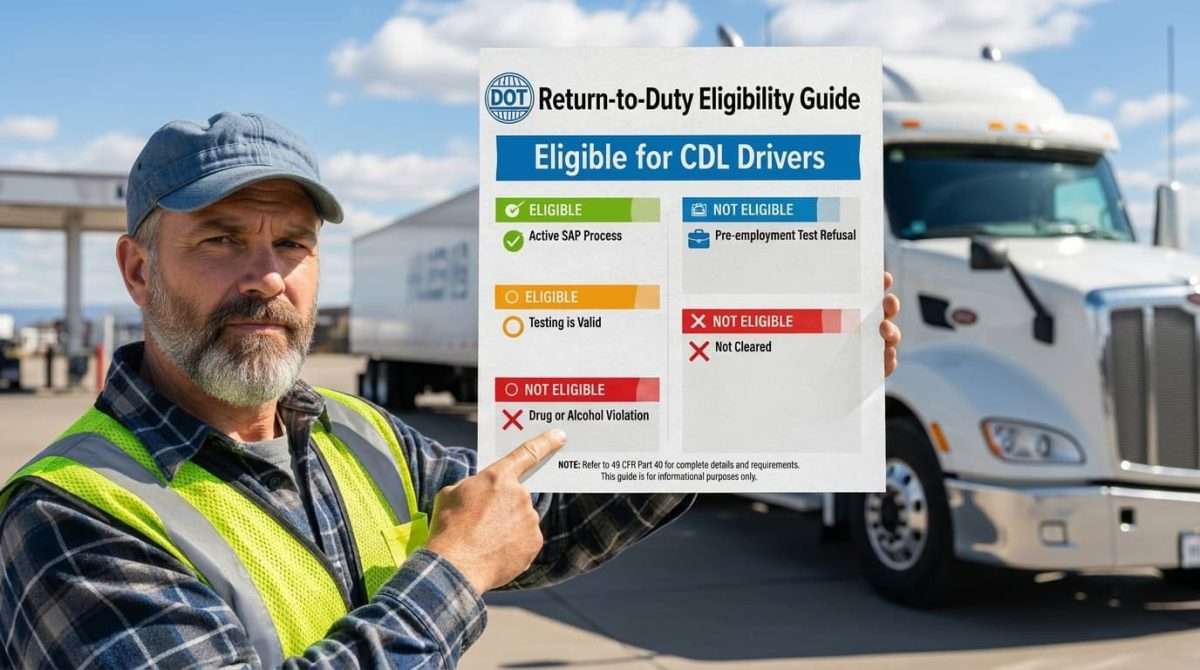
A DOT drug or alcohol violation can place a commercial driver’s career on hold immediately. Whether the violation involves a failed drug test, alcohol misuse, or refusal to test, federal regulations require drivers to complete a structured return-to-duty process before they can legally resume safety-sensitive work. Many CDL drivers assume they are cleared to drive once they complete counseling or pass a return-to-duty drug test. Unfortunately, that is not always enough. DOT return-to-duty eligibility depends on several compliance steps involving the FMCSA Drug and Alcohol Clearinghouse, a qualified Substance Abuse Professional (SAP), employer reporting, and follow-up testing requirements. Failing to complete even one part of the process can delay employment opportunities and keep your Clearinghouse status marked as prohibited. This guide explains how DOT return-to-duty eligibility works, how to verify your status correctly, and what drivers need to know before returning to work legally. What Is DOT Return-to-Duty Eligibility? DOT return-to-duty eligibility refers to a driver’s legal authorization to resume safety-sensitive duties after violating Department of Transportation drug and alcohol regulations. DOT-regulated safety-sensitive employees include: CDL truck drivers Bus drivers Pipeline workers Railroad employees Aviation personnel Transit operators Under FMCSA regulations, employees who violate DOT drug and alcohol testing rules must complete the SAP return-to-duty process before they can operate commercial vehicles again. Common violations include: Positive DOT drug test Positive alcohol test Refusal to test Adulterated or substituted samples Failure to comply with testing procedures Once a violation occurs, the driver is immediately removed from safety-sensitive duties and listed in the FMCSA Drug and Alcohol Clearinghouse as prohibited. Source: FMCSA Return-to-Duty Process Why DOT Return-to-Duty Eligibility Matters The FMCSA Clearinghouse has changed how employers monitor CDL driver compliance. Before hiring a driver, employers are required to check Clearinghouse records for unresolved drug and alcohol violations. If a driver’s status still shows prohibited, they cannot legally perform safety-sensitive work regardless of whether they completed treatment independently. This makes DOT return-to-duty eligibility one of the most important compliance requirements for commercial drivers after a violation. What Happens After a DOT Violation? After a DOT drug or alcohol violation, the employer must immediately remove the driver from safety-sensitive duties. The violation is then reported to the FMCSA Drug and Alcohol Clearinghouse. At this stage: The driver cannot legally operate a commercial vehicle Employers can view the violation history Future employment opportunities may be affected The SAP process becomes mandatory The only path back to legal driving status is successful completion of the DOT return-to-duty process. DOT Return-to-Duty Process Explained Understanding each phase of the process is critical because DOT return-to-duty eligibility depends on completing every requirement properly. 1. SAP Initial Evaluation The first step is scheduling an evaluation with a DOT-qualified Substance Abuse Professional. The SAP conducts a confidential assessment to evaluate: Substance use history Violation circumstances Behavioral concerns Risk factors Treatment needs The SAP’s role is not to punish drivers. Instead, they determine the appropriate education or treatment plan necessary for safe return to duty. Source: SAPvaluate DOT SAP Program 2. Education or Treatment Program After the evaluation, the SAP creates a personalized recovery or education plan. Depending on the assessment, recommendations may include: Drug education classes Alcohol awareness programs Counseling sessions Outpatient treatment Inpatient rehabilitation Recovery monitoring The timeline varies based on the driver’s situation and SAP recommendations. Drivers cannot move to the next stage until all required programs are completed successfully. 3. Follow-Up SAP Evaluation Once treatment or education is complete, the driver attends a follow-up SAP evaluation. During this meeting, the SAP reviews: Program completion records Compliance progress Recovery commitment Readiness to resume safety-sensitive duties If the SAP determines the driver has complied successfully, they authorize the return-to-duty test. Without SAP approval, drivers cannot proceed legally. DOT Return-to-Duty Process Overview Step Requirement Purpose 1 SAP Initial Evaluation Assess violation and determine treatment needs 2 Education or Treatment Complete required recovery or educational program 3 Follow-Up SAP Evaluation Confirm compliance and readiness 4 Return-to-Duty Test Verify negative drug or alcohol result 5 Clearinghouse Update Restore eligible driving status 6 Follow-Up Testing Program Monitor long-term compliance 4. Return-to-Duty Drug or Alcohol Test The return-to-duty test is conducted under direct observation and must produce a negative result before the driver can return to safety-sensitive work. For alcohol violations, the alcohol concentration level must fall below DOT limits. Many drivers believe this test automatically restores their CDL eligibility. However, DOT return-to-duty eligibility still depends on Clearinghouse updates and employer reporting. Source: FMCSA Drug and Alcohol Regulations 5. Clearinghouse Status Update One of the most overlooked parts of the process is the FMCSA Clearinghouse update. After the negative return-to-duty test is completed, the employer or designated representative must upload the information into the Clearinghouse system. Only then does the driver’s status change from prohibited to eligible. If this step is delayed or incomplete, employers may still see the driver as prohibited even after all SAP requirements are finished. How to Verify Your DOT Return-to-Duty Eligibility Drivers should never rely only on verbal confirmation from employers or treatment providers. The best way to verify DOT return-to-duty eligibility is through official compliance records. Check Your FMCSA Clearinghouse Account Drivers should log into their FMCSA Clearinghouse profile and confirm: Violation information is accurate SAP completion is documented Return-to-duty test results are uploaded Current status no longer says prohibited This is the most reliable verification method available. Source: FMCSA Drug and Alcohol Clearinghouse Confirm SAP Documentation Drivers should maintain copies of: SAP evaluations Treatment completion records Follow-up reports Return-to-duty test results Having complete records can help prevent hiring delays or compliance disputes. Verify Employer Reporting Some drivers complete every requirement correctly but remain prohibited because the employer failed to submit the final Clearinghouse updates. This is why personal verification is essential. Understand Follow-Up Testing Requirements After returning to duty, the SAP creates a follow-up testing plan. DOT regulations allow follow-up testing for up to five years depending on the SAP’s recommendations. These tests are separate from random DOT testing and are mandatory for maintaining compliance. Source: