
Rebuilding Your Trucking Career After an SAP Violation

A DOT SAP violation can feel like the end of your trucking career. Many CDL drivers panic after a failed or refused drug or alcohol test, assuming they will never drive again. The truth is very different. Thousands of drivers successfully return to the road every year after completing the required DOT SAP program. If you follow the correct process and work with a reliable provider, you can rebuild your career, restore your eligibility, and get back behind the wheel faster than you might expect. This guide explains exactly how truck drivers recover from an SAP violation and how an affordable service like SAPvaluate can help you complete the process with one of the cheapest DOT SAP programs available online. Understanding an SAP Violation in the Trucking Industry Under Department of Transportation regulations, CDL drivers must follow strict drug and alcohol testing rules. A violation can occur if a driver: Fails a drug test Has an alcohol level of 0.04 BAC or higher Refuses to take a required drug or alcohol test Submits an adulterated or substituted sample Leaves the testing site before completion When a violation occurs, the driver is immediately removed from safety-sensitive duties and cannot legally operate a commercial vehicle. Your status is also recorded in the FMCSA Clearinghouse, which every trucking employer must check before hiring drivers. Until you complete the SAP return-to-duty process, you remain in “prohibited” status, meaning no DOT-regulated company can legally employ you. The Good News: An SAP Violation Is Not the End Many drivers believe that once they fail a DOT drug test, their CDL career is permanently over. That is simply not true. The Substance Abuse Professional (SAP) program exists specifically to give drivers a structured path back to work. The program evaluates the driver, recommends education or treatment if necessary, and verifies when the driver is ready to safely return to duty. Once the process is completed and the return-to-duty test is passed, drivers become eligible to work again in DOT-regulated positions. In other words, the SAP process is designed to restore careers—not end them. The DOT SAP Return-to-Duty Process To rebuild your trucking career after a violation, you must complete the federally required SAP program steps. 1. Choose a DOT-Qualified SAP The first step is selecting a certified Substance Abuse Professional who will evaluate your case and guide you through the process. DOT rules require that the SAP be properly trained and licensed. 2. Complete the Initial SAP Evaluation During the evaluation, the SAP reviews your situation, substance use history, and any risk factors to determine the appropriate next steps. 3. Follow the Recommended Education or Treatment Based on the evaluation, the SAP may recommend: Educational programs Counseling sessions Substance abuse treatment Support group participation You must complete all requirements before moving forward. 4. Follow-Up SAP Evaluation After completing the recommendations, you meet with the SAP again. If the professional confirms that you followed the program successfully, they authorize you for the next step. 5. Pass the Return-to-Duty Drug Test A negative return-to-duty test is required before you can legally operate a commercial vehicle again. 6. Complete Follow-Up Testing Even after returning to work, the SAP typically requires at least six unannounced follow-up tests over 1–5 years to ensure ongoing compliance. Once these steps are complete, you regain full eligibility to continue your trucking career. Challenges Drivers Face After an SAP Violation Even though the process exists to help drivers return to work, many drivers face a few challenges along the way: High Costs Some SAP providers charge hundreds or even thousands of dollars, making the process financially stressful for drivers already out of work. Confusing Regulations DOT compliance rules can be complicated, especially for drivers unfamiliar with the Clearinghouse system. Delays in Scheduling Slow evaluations or paperwork delays can keep drivers off the road longer than necessary. This is why choosing the right SAP provider is critical. Finding an Affordable DOT SAP Program One of the biggest concerns for drivers is cost. Many SAP services charge expensive fees that make the process even harder. Platforms like SAPvaluate help drivers by offering one of the most affordable DOT SAP evaluation programs available nationwide. Their services include: Affordable SAP evaluations starting around $124 Pay-in-installment options Nationwide online appointments Fast documentation processing Same-day scheduling availability This makes it easier for drivers to start the process quickly without paying thousands upfront. For many drivers searching for the cheapest DOT SAP program, affordability combined with compliance is essential. Tips for Rebuilding Your Trucking Career Completing the SAP process is just the first step. Here are several ways drivers successfully rebuild their careers afterward. Be Honest With Employers Some trucking companies hire drivers who have completed the SAP return-to-duty process. Transparency builds trust. Focus on Safety and Compliance After returning to work, maintaining a clean record is essential for rebuilding your reputation. Continue Professional Development Training, certifications, and strong performance records can help demonstrate reliability to future employers. Act Quickly After a Violation The sooner you begin the SAP process, the sooner you can return to driving. Why Acting Fast Matters Delaying the SAP program can have serious consequences. Drivers who do not complete the process remain listed as prohibited in the FMCSA Clearinghouse, meaning they cannot legally work in any DOT-regulated driving position. The longer the process is delayed, the longer a driver remains off the road and unable to earn income. Starting your SAP evaluation immediately is the fastest way to restore your CDL career. Get Back on the Road with Confidence A DOT SAP violation may feel overwhelming, but it does not have to define your future. With the right guidance, a structured plan, and an affordable SAP evaluation provider, you can: Complete the DOT SAP program Clear your prohibited status Pass your return-to-duty test Get back to work as a CDL driver Services like SAPvaluate are designed to simplify the process and provide one of the cheapest DOT SAP programs available online, helping drivers return to the road
Best DOT SAP Providers 2026

What Happens If You Quit Before Completing a SAP Program?

Failing or refusing a DOT drug or alcohol test changes a commercial driver’s career overnight. Most drivers understand they must complete the Substance Abuse Professional process to return to duty. But many begin the program and then stop halfway through. Sometimes the employer fires them. Sometimes money becomes tight. Sometimes they assume the violation will eventually disappear. So the real concern becomes: What actually happens if you quit the SAP program before finishing it? The answer is important because walking away does not cancel the violation. It freezes your professional eligibility. You are not permanently banned from driving, but legally you cannot perform safety sensitive work again until completion. This article explains the full legal impact, career consequences, Clearinghouse status, CDL effects, hiring barriers, and exactly how to recover even years later. Understanding the Purpose of the SAP Program The Substance Abuse Professional process is not punishment. It is a federal safety clearance system created by the U.S. Department of Transportation and enforced for trucking by the Federal Motor Carrier Safety Administration. The program determines one thing only: Whether a driver is safe to return to safety sensitive work. It does not decide employment. It does not suspend your CDL by itself. It does not permanently blacklist you. Instead it creates a compliance pathway: 1- Initial clinical evaluation2- Education or treatment3- Follow up evaluation4- Return to duty test5- Follow up testing plan Only after those steps can a driver legally operate a commercial motor vehicle again. The Biggest Misunderstanding Drivers Have Many drivers believe quitting the program resets everything. It does not. The violation remains active inside the Clearinghouse until completion. Time does not remove it. Changing employers does not remove it. Moving states does not remove it. Your status simply remains prohibited. Think of it as a locked door that only opens when the full process is completed. What Immediately Happens After You Quit the SAP Process Your Clearinghouse Record Stops Progressing The moment you stop attending required education or fail to complete recommendations, the SAP cannot mark compliance. Your Clearinghouse status stays: Prohibited That means every DOT employer in the country sees the same thing during a pre employment query. They cannot legally allow you to drive. Employers Cannot Override It Even if a company wants to help you, federal regulations prevent them from putting you in a safety sensitive position. Hiring you without completion would be a regulatory violation. So the issue is not willingness.It is legality. Can You Still Get a Job Somewhere Else Yes and no. You can still be hired for non safety sensitive work such as warehouse, yard spotting that does not require CDL operation, dispatch, or office positions. But you cannot perform any duty requiring a CDL in interstate commerce. This means: You may keep your license You may keep endorsements You may keep experience But you cannot legally use them for work. What Happens to Your CDL License Many states now connect licensing systems to the Clearinghouse. If you abandon the SAP process: Some states downgrade your CDL to a regular license Some prevent renewal Some prevent transferring to another state Some block hazmat renewals The downgrade remains until completion of return to duty testing. So while the violation itself is federal, its practical impact becomes state level licensing restrictions. The Five Year Myth Drivers often hear the violation disappears after five years. That is incorrect in practice. The Clearinghouse keeps the record for five years from the date of violation or until the return to duty process is completed, whichever occurs later. If you never finish, the later date never occurs. So the violation effectively stays active indefinitely. Waiting actually extends the problem. Real Life Example Scenario A driver fails a random test in 2022. He completes the evaluation but never attends education classes. He leaves trucking and works construction for four years. In 2026 he wants to drive again. The Clearinghouse still shows prohibited status. He must resume the SAP process before any employer can use him as a driver. Nothing was erased. Do You Start Over If You Return Later Not always. You usually do not repeat everything from the beginning but the SAP must reassess your situation because treatment recommendations expire in clinical relevance. Here is what typically happens: If you never did the first evaluationYou schedule a new evaluation If you completed evaluation but no educationThe SAP may update recommendations If treatment was partially completedYou finish remaining requirements If all steps done except return to duty testYou continue with a new employer The goal is not punishment. The goal is verifying safety risk again. Why Drivers Quit Midway Understanding the psychology helps explain why abandonment is common. Cost Concerns Drivers worry about paying before having a job. Employer Termination They believe no job means no reason to continue. Embarrassment They want to distance themselves from the violation. Misleading Advice They are told to wait it out. Career Change They temporarily leave trucking. Ironically, every one of these reasons makes returning harder later. The Financial Reality of Delaying Stopping feels like saving money. But the real cost is lost earning power. Average CDL income per year exceeds most alternative jobs available without clearance. Delaying return to duty often costs tens of thousands more than completing the program promptly. The longer you wait, the more experience gap appears on your record which affects hiring confidence. What Employers Actually Think About Old Violations Contrary to driver fears, companies care less about past violations than about unresolved ones. Completed violation shows responsibility. Incomplete violation shows uncertainty. From a risk management perspective, a driver who finished SAP quickly is statistically lower risk than a driver avoiding completion for years. The Return Path After Quitting The process to come back is straightforward and always the same. 1- Contact a qualified SAP provider such as SAPvaluate2- Schedule updated evaluation3- Complete any remaining education or treatment4- Obtain compliance report5- Employer orders return to duty test6- Negative result restores eligibility After that, the
What If My Employer Won’t Cooperate With the SAP Process?

A complete guide for DOT employees facing Return-to-Duty roadblocks Failing a DOT drug or alcohol test can be overwhelming — but many safety-sensitive employees are shocked to discover something even more frustrating: Their employer refuses to respond, ignores the SAP process, or even blocks the return-to-duty procedure entirely. It’s a common misconception that the employer has control over whether you can return to work. They don’t. Under federal law regulated by the U.S. Department of Transportation and enforced through Federal Motor Carrier Safety Administration rules (49 CFR Part 40), your ability to complete the SAP program and regain eligibility is independent of employer cooperation. This guide explains exactly what happens, what your rights are, and how to move forward even if your company disappears or refuses to help. First Understand What the SAP Process Actually Does The Substance Abuse Professional (SAP) program is not employer-controlled discipline. It is a federal safety clearance process. Its purpose: Evaluate risk to public safety Ensure education/treatment Verify compliance Restore DOT eligibility Once completed, you become legally eligible for safety-sensitive work again, whether with your old employer or a new one. That distinction changes everything. The Biggest Myth: “My Employer Has to Approve Me” No. Your employer does NOT: Approve your SAP Clear you to work DOT jobs Decide your eligibility status They only: Order a return-to-duty test if you still work there Or simply do nothing (very common) Your actual eligibility status is determined by: The SAP + Follow-Up Testing Plan + Negative Return-to-Duty Test Not employer permission. Why Employers Sometimes Refuse to Cooperate This happens far more often than drivers expect. Here are the most common reasons: 1. Company Policy (Zero-Tolerance) Some carriers permanently terminate drivers after violations. They won’t respond to SAP emails because they never intend to rehire you. 2. Administrative Burden Return-to-Duty requires: Scheduling a test Clearing Clearinghouse status Managing follow-ups Many small carriers simply ignore the process. 3. Insurance Issues Their insurance provider may prohibit rehiring after a violation. 4. They Already Replaced You They moved on and legally they can. Important: They Are NOT Required to Take You Back Employers must report violations. They are not required to rehire you. But they also cannot block your eligibility. What Actually Happens When They Don’t Cooperate Nothing bad happens to your SAP progress. Your case continues normally. The SAP will: Evaluate you Assign education/treatment Conduct follow-up evaluation Mark you “Eligible for Return-to-Duty” At that point: You are legally cleared to work for ANY DOT employer willing to hire you. The Clearinghouse Is What Matters Not the Employer Your record in the FMCSA Clearinghouse will show: Status Meaning Prohibited You cannot work In Progress Completing SAP Eligible You can be hired again Once “Eligible” appears, the process is complete. Your former employer has no authority over that status. How You Return to Work Without Employer Cooperation This is the most important part. Step-by-Step Step 1: Complete SAP Finish evaluation and recommendations. Step 2: Get Eligibility Status Your SAP marks you compliant. Step 3: Find New Employer Apply normally disclose violation honestly. Step 4: New Employer Orders Return-to-Duty Test They become the testing employer. Step 5: Pass Test You are fully reinstated. What the Law Actually Requires Regulations require: A DOT employer must conduct a return-to-duty test before you perform safety-sensitive duties but it does NOT have to be the same employer. This is why drivers switch companies after violations. If Your Employer Ignores the SAP Your SAP will document: “Employer non-responsive” This is extremely common and does NOT hurt your case. You simply continue and later use a new employer as the testing employer. Can an Employer Delay Your Process? No. They cannot: Cancel your SAP Block eligibility Prevent completion Remove you from the Clearinghouse Control follow-ups They only control whether you work for them nothing more. The Biggest Mistake Drivers Make Many drivers wait months thinking: “I can’t do anything until my company responds.” This delays their career unnecessarily. You should continue immediately. Special Case: Owner-Operators If you are an owner-operator with no employer: You will use a Consortium/Third-Party Administrator (C/TPA) as your employer for testing purposes. This allows full reinstatement without a carrier. Will New Employers Hire You After SAP? Yes, but preparation matters. Best practices: Be honest Show SAP completion proof Provide follow-up plan Apply to second-chance carriers Many companies specifically hire post-SAP drivers. What Employers Care About Most Not the violation. They care about: Completed SAP Clean return-to-duty test Compliance attitude Drivers who complete SAP quickly are often viewed as lower risk than those who delay. Frequently Asked Questions Can my employer refuse to schedule my return-to-duty test?Yes, an employer can refuse to schedule your return-to-duty test, but you have the option to take it with a new employer once they agree to allow you back into a safety-sensitive role. Will I stay prohibited forever?No, you will only remain prohibited from performing safety-sensitive duties until you complete the necessary requirements with a Substance Abuse Professional (SAP) and meet all return-to-duty protocols. Do I need permission to start SAP?No, you can begin the SAP process on your own. There’s no need for permission from your employer, although your employer will need to be notified once you start the process. Can I switch SAPs if employer disappears?Yes, you can switch SAPs if your employer is no longer available. You’ll need to find a new SAP to continue the process and stay compliant with DOT regulations. Does ignoring SAP hurt my CDL?Yes, ignoring the SAP process will lead to indefinite disqualification from safety-sensitive duties. You must complete the SAP requirements to lift the prohibition and reinstate your CDL privileges. Key Takeaways Your employer does NOT control your DOT eligibility SAP completion restores legal work status A new employer can perform the return-to-duty test Waiting for employer cooperation wastes time You can move forward immediately Conclusion Employer non-cooperation is common, but it does not stop your career. The DOT system was designed specifically so drivers are not trapped by former employers.
FAA SAP Return-to-Duty Evaluations Online: A Guide for Aviation Safety Professionals

Failing a drug or alcohol test in a Federal Aviation Administration (FAA) safety-sensitive role, whether you’re a pilot, air traffic controller, flight attendant, or mechanic, can feel like your career is on hold. But there’s a structured and federally mandated process that gives you a path back: the FAA SAP Return-to-Duty Evaluation. Thanks to advances in telehealth and regulatory acceptance of remote assessments, FAA SAP Return-to-Duty Evaluations Online have become a trusted and accessible solution for aviation professionals nationwide. In this comprehensive guide, we’ll walk through everything you need to know about FAA SAP Return-to-Duty Evaluations, from regulations and requirements to the online process and best practices for successful compliance. What is an FAA SAP Return-to-Duty Evaluation? A Return-to-Duty (RTD) evaluation is a mandatory assessment that an aviation employee must complete after violating FAA or Department of Transportation (DOT) drug and alcohol testing regulations. This process ensures that individuals are fit to safely perform safety-sensitive functions again. Under FAA rules, you cannot return to safety-sensitive duties until you complete the SAP process in accordance with 49 CFR Part 40 and FAA policy. This includes: An initial substance abuse evaluation by a qualified Substance Abuse Professional (SAP), Any recommended education or treatment, A follow-up evaluation, A negative return-to-duty drug test, Follow-up testing as prescribed by the SAP. This applies to FAA safety-sensitive employees (pilots, air traffic controllers, mechanics, flight attendants, etc.) who have either failed or refused a DOT drug/alcohol test or violated FAA substance use policy. Why the SAP Return-to-Duty Process Matters The FAA and DOT prioritise safety above all. Substance misuse in safety-sensitive roles increases risk, not just for the individual, but for passengers, coworkers, and the public. The SAP process protects the integrity of safety-sensitive operations by: Assessing clinical needs related to substance use, Ensuring proper education and treatment when necessary, Verifying recovery and readiness before the employee returns to duty, Maintaining compliance with federal regulations. Completing the SAP process successfully protects your career, certification, and health while demonstrating a commitment to safety and compliance. FAA & DOT Regulatory Framework FAA Standards Under FAA policy and 14 CFR Part 120, any violation of drug and alcohol testing rules triggers the requirement to complete the return-to-duty process as described in 49 CFR Part 40 Subpart O. FAA defines safety-sensitive functions broadly, from cockpit duties and air traffic control to aircraft maintenance that directly affects flight safety. 49 CFR Part 40: The Core Regulations Part 40 is the federal regulation that governs the SAP Return-to-Duty process and specifies: Who qualifies as a Substance Abuse Professional, What must occur during initial and follow-up evaluations, What reports must be provided to employers, Requirements for documentation and follow-up testing plans. Under Part 40, evaluation and education must be individualised, cookie-cutter treatments are not compliant. SAPs must provide tailored recommendations based on a thorough clinical assessment. Return-to-Duty Conclusion Requirements Employees may only resume safety-sensitive duties once: The SAP confirms full compliance with treatment/education, A negative return-to-duty drug and/or alcohol test is obtained, The employer authorises return to duty. Employers retain discretion over re-employment decisions even after regulatory requirements are satisfied. Online vs. In-Person SAP Evaluations Historically, SAP evaluations were completed in person, but federal guidelines allow face-to-face evaluations to be conducted in person or remotely. Remote evaluations, typically via Zoom or telehealth platforms, are now widely accepted by employers, the FAA, and DOT regulators. Benefits of Online SAP Return-to-Duty Evaluations 1. Flexibility & ConvenienceAviation professionals often travel or relocate. Online SAP evaluations eliminate travel time and scheduling hurdles. 2. Speed of ServiceRemote appointments can typically be scheduled faster than in-person visits, often within days. 3. Nationwide AccessYou can complete evaluations from anywhere in the U.S., which is essential for pilots, controllers, and other mobile professionals. 4. Peace of MindTelehealth platforms are private, confidential, and compliant with HIPAA and federal telehealth standards. Compliance & Acceptance Online SAP evaluations must meet all regulatory requirements, the method (virtual vs. in-person) does not change the validity of the evaluation as long as the SAP follows Part 40 procedures. Step-by-Step: FAA SAP Return-to-Duty Online Process Here is how an online SAP Return-to-Duty evaluation typically works: 1. Schedule Your Initial Evaluation Book your initial SAP appointment, often online or by phone. Qualified SAPs are experienced with FAA/DOT regulation and meet federal certification requirements. At SAPvaluate, for example, evaluations are completed via Zoom by DOT-qualified SAP clinicians. 2. Initial SAP Evaluation During the first session, the SAP will: Review your substance use history, Assess the circumstances of the violation, Discuss any relevant medical and psychological history, Determine whether treatment or education is needed. This evaluation is comprehensive and personal, not one-size-fits-all. Based on the assessment, the SAP may recommend one or more of the following: Education programs, Counseling sessions, Treatment plans tailored to your needs. These recommendations must comply with federal requirements. 3. Complete Recommended Education or Treatment Once recommendations are made, you must complete those programs before the next step. Your SAP will provide instructions and details on approved providers for education, counseling, or treatment services. Whether conducted online or in person, this is a crucial phase in the RTD process. 4. Follow-Up SAP Evaluation After completing all prescribed courses, you return to the SAP for a follow-up evaluation. The SAP will review: Your participation in recommended programs, Progress made, Evidence of compliance with treatment or education efforts. If the SAP determines you have successfully completed requirements, they prepare a follow-up report that is fed into your employer and federal systems. 5. Return-to-Duty Testing Once SAP compliance is documented: A return-to-duty drug and/or alcohol test is scheduled, You must receive a negative result (negative drug test and/or alcohol <0.02), and This test must meet FAA and DOT testing standards. Only after a negative test can you legally resume safety-sensitive duties. 6. Follow-Up Testing Program SAPs often prescribe follow-up tests, at least six in the first 12 months, and potentially up to 60 months of random testing. This helps ensure ongoing compliance and supports long-term safety. Common FAQs Q: How long does
SAP Program Compliance Guide for Trucking Companies 2026
FMCSA enforcement is stricter than ever. In 2026, carriers must be prepared for: Automated Clearinghouse alerts More state-level CDL downgrades Increased employer reporting requirements Expanded audit focus areas Higher financial penalties Key employer responsibilities include: Immediately removing drivers from safety-sensitive duties Providing a DOT-qualified SAP list (49 CFR §40.287) Reporting violations within 3 business days Conducting Clearinghouse queries (pre-employment + annual) Ensuring RTD testing and follow-up test completion Retaining SAP-related records for 5 years Failure to follow these steps can result in: FMCSA fines, out-of-service orders, CSA score damage, insurance increases, and loss of operating authority. This guide is for fleet managers, safety directors, compliance officers, and trucking company owners. It includes DOT/FMCSA compliance requirements, best practices, employer responsibilities, common pitfalls, recordkeeping, audit readiness, and real-world guidance validated by official regulations. The Substance Abuse Professional (SAP) Program remains one of the most regulated and closely monitored compliance requirements in the trucking industry. As federal rules evolve under FMCSA, DOT, and the Clearinghouse, trucking companies must stay ahead of regulatory changes, especially those involving drug and alcohol violations, SAP enrollments, and return-to-duty (RTD) processes. In 2026, more carriers are facing increased audits, higher scrutiny from insurance providers, and stricter FMCSA oversight. Non-compliance is no longer just a risk, it’s an operational threat that can lead to hefty fines, out-of-service orders, and federal violations that impact CSA scores. This guide provides a comprehensive breakdown of everything trucking companies must know to stay compliant with the latest SAP and Clearinghouse regulations. What Is the DOT SAP Program? The SAP Program is a mandatory federal return-to-duty process that applies when drivers in safety-sensitive positions violate DOT drug and alcohol testing rules. Those violations include: Positive drug test results Positive alcohol test results (BAC ≥ 0.04) Refusal to submit to testing Adulterated or substituted samples Failure to cooperate with testing procedures The SAP program is required under: 49 CFR Part 40 FMCSA Clearinghouse regulations DOT drug & alcohol testing rules In 2026, these rules continue to apply to all CDL drivers working in safety-sensitive positions, including: Truck drivers (all CDL classes) Bus drivers Owner-operators Mechanics who operate CMVs Dispatchers performing safety-sensitive tasks Once a violation occurs, the driver must be removed from safety-sensitive duties and entered into the FMCSA Drug & Alcohol Clearinghouse. They cannot return to safety-sensitive functions such as driving until they complete all steps of the SAP process, including evaluation, recommended treatment or education, a negative Return-to-Duty (RTD) test, and follow-up testing as required. Why SAP Compliance Matters for Trucking Companies SAP compliance is much more than a checkbox, it’s a legal imperative. Failing to adhere to SAP compliance can result in: 1. Federal Fines and Penalties DOT can impose civil penalties for noncompliance with drug and alcohol program requirements. These fines can accumulate quickly per violation. Violations may trigger penalties such as: $5,833 per violation for failing to maintain drug testing programs $10,000+ for knowingly using a prohibited driver Up to $225,000 for hazmat-related SAP violations 2. FMCSA Audits and Out-of-Service Orders Noncompliance discovered during FMCSA audits may result in an out-of-service (OOS) order or reduced safety ratings. Carriers may be placed out-of-service for: Allowing prohibited drivers to operate Failing to follow SAP return-to-duty steps Not performing required queries 3. Loss of Operating Authority Chronic noncompliance can influence a carrier’s safety rating and impact operating authority with state and federal regulators. 4. Insurance and Contractual Issues Insurance providers may raise premiums or drop coverage for carriers with poor compliance histories. Clients and shippers may also require strict SAP compliance. 5. CSA Score Impact SAP-related violations affect: Drug/Alcohol BASIC Crash Indicator BASIC Unsafe Driving BASIC Poor scores can trigger: Insurance hikes Increased roadside inspections Safety ratings downgrades Employer Responsibilities Under DOT SAP Rules Effective SAP compliance starts with understanding what trucking companies must do the moment a DOT drug or alcohol violation is identified. Below are the core employer responsibilities: 1. Immediate Removal of the Driver from Safety-Sensitive Duties Once a driver fails or refuses a DOT test, you must immediately remove them from safety-sensitive duties such as driving, loading hazardous materials, or performing safety-critical functions. Allowing a prohibited driver to operate a commercial vehicle is a DOT violation itself. 2. Provide the Employee with a List of Qualified SAPs According to DOT rule 49 CFR §40.287, employers must provide the driver with an up-to-date list of DOT-qualified SAPs. Employers do not have to pay for SAP evaluations or treatment, but they must ensure drivers are informed about qualified professionals they can contact. 3. Report Violations Within 3 Business Days Employers are legally required to report verified positive test results, refusals to test, and other violations to the FMCSA Clearinghouse within three business days. Reporting delays or failures are compliance violations. 4. Conduct Pre-Employment and Annual Clearinghouse Queries Before hiring or rehiring a driver, trucking companies must run a full Clearinghouse query with the driver’s consent to ensure they are not in “prohibited” status. Additionally, at least annual limited queries of current drivers must be conducted to monitor any new violations. 5. Ensure Proper Return-to-Duty Testing and Follow-Up Once a driver completes SAP-recommended treatment or education, they must pass a negative RTD test before returning to safety-sensitive duties. After RTD, employers must implement the SAP’s follow-up testing plan, which typically includes a minimum of six unannounced tests over 12–60 months. 6. Maintain Comprehensive Records DOT requires carriers to maintain detailed documentation of SAP referrals, evaluation results, Return-to-Duty test results, and follow-up records for at least five years. Accurate records are essential for DOT audit readiness. Key Updates Affecting Trucking Companies in 2026 Based on 2024–2026 FMCSA regulatory announcements and common industry trends, here are the major updates affecting SAP compliance this year: 1. Increased Clearinghouse Cross-Agency Visibility FMCSA now shares violation and SAP status data more directly with: State Driver Licensing Agencies (SDLAs) Insurance companies (indirectly through risk data) Employers during pre-hire queries If a driver has not completed RTD requirements, they cannot legally operate a CMV, and the SDLA
FMCSA & DOT SAP Program: What Employers Can See, What Drivers Can’t Hide (2026 Update)
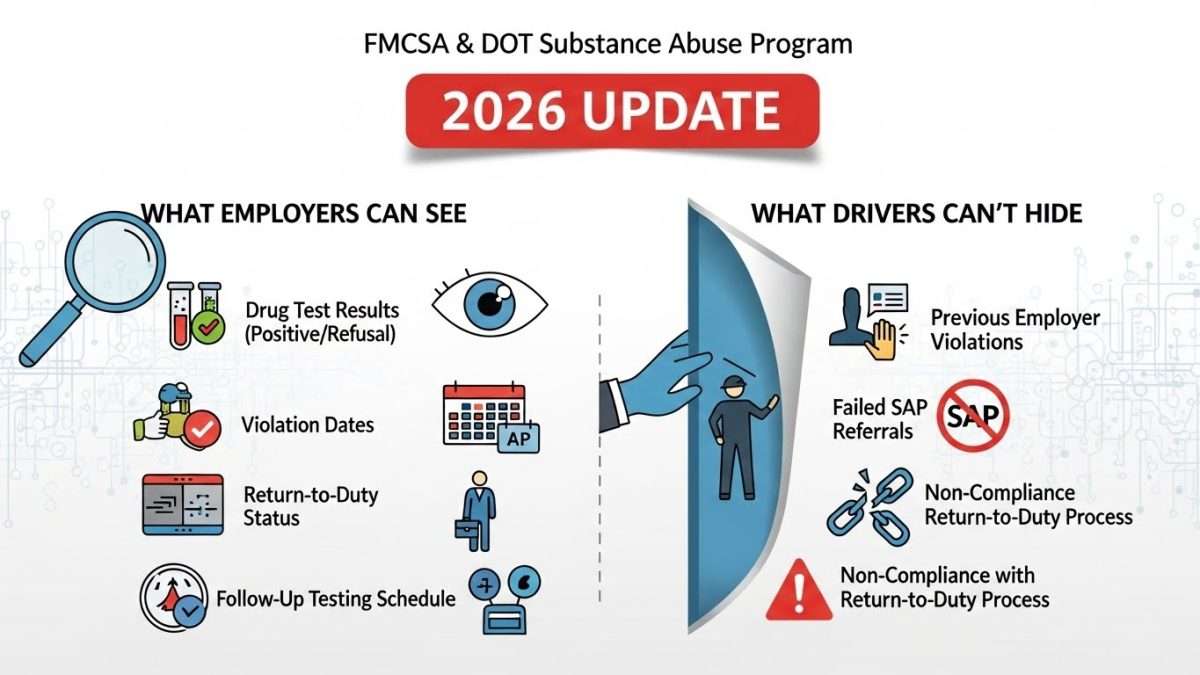
In the Department of Transportation (DOT) regulated world, transparency and compliance matter, especially when it comes to drug and alcohol violations, Substance Abuse Professional (SAP) evaluations, and the FMCSA Drug & Alcohol Clearinghouse. Both employers and drivers often ask: What does the FMCSA Clearinghouse show? What can employers see about a driver’s SAP violation history? Can drivers hide anything in their record? What records stay visible even after completion of SAP steps? This article answers all these questions clearly, with regulation-based facts and real-world examples. 1. What Is the FMCSA Clearinghouse? “The Clearinghouse contains records of drug and alcohol violations, including positive tests and refusals, and these records remain for five years or until the return-to-duty process is completed, whichever is later.” FMCSA Regulations It was created to improve highway safety by allowing employers and regulators to see whether a driver: Has a drug or alcohol violation Completed a SAP evaluation Completed recommended treatment/education Took a Return-to-Duty (RTD) test Is part of a follow-up testing plan All employers of CDL and commercial operator drivers are required to check the FMCSA Clearinghouse before hiring and annually afterward. It’s not optional, federal law mandates it. 2. What Information Employers Can See “The Clearinghouse contains records of violations of drug and alcohol prohibitions in 49 CFR Part 382, including positive drug or alcohol test results and test refusals. When a driver completes the return-to-duty process and follow-up testing plan, this information is also recorded.” Employers can see comprehensive compliance history of each driver, including: a. Positive Drug & Alcohol Tests Employers see: The date of the violation Type of test (drug vs. alcohol) Type of substance or behavior Test status This gives insight into whether the driver has had a workplace drug or alcohol issue. b. Refusals to Test Refusing a DOT-mandated test is treated as a positive violation and is fully visible. Employers can see: Refusal status Dates Reason for refusal This matters just as much as a positive test result. c. SAP Evaluation Status Employers can see whether a driver: Has been referred to a SAP Completed the SAP evaluation Completed required education/treatment Was given a follow-up plan Is eligible for Return-to-Duty testing This gives employers insight into where the driver is in the compliance process. d. Return-to-Duty Test Results Post-SAP evaluation, the driver must take a Return-to-Duty test. Employers will see: Test completion date Result (negative or positive) Only a negative result clears the driver for safety-sensitive duties. e. Follow-Up Testing Plan Employers can also see: Whether a follow-up testing plan exists How long it lasts (12–60 months) Whether the driver is meeting follow-up requirements 3. What Information Drivers Cannot Hide “Clearinghouse information is not publicly available; only authorized employers or consortia with driver consent can view detailed violation records.” Read More At: How is driver data protected in the Clearinghouse? Once a drug or alcohol violation hits the system: Drivers cannot delete the record They cannot hide the SAP referral They cannot conceal test results Under federal law, all violations and SAP steps go into the Clearinghouse, and employers must check it. This means even if a driver: Changes employers Moves states Tries to restart the process Pays fines or settlements … the history remains in the Clearinghouse. 4. What Drivers Can’t Hide (Even After Completing SAP Steps) Even after completing every step, the following stays visible: a. Violation History Whether you passed SAP evaluations or not, your violation is still listed. b. Return-to-Duty Eligibility A driver who completed the SAP program is listed as eligible to return to duty, not erased. c. Positive Test History The fact that a positive test occurred is permanent within the FMCSA’s database. Even successful completion doesn’t make the violation disappear. It simply changes the status from “prohibited” to “eligible.” 5. What Drivers Can Hide or Remove “Drivers can view their own Clearinghouse record at no cost, but they cannot view other drivers’ records.” Read More At: How is driver data protected in the Clearinghouse? While violations stay in the Clearinghouse for at least 5 years, certain things are not visible to employers: Non-DOT drug/alcohol violations DOT’s Clearinghouse only stores DOT-mandated testing results. Non-CDL traffic violations (e.g., speeding tickets) These are not part of FMCSA data. Medical records or unrelated drug treatment Only SAP-related (DOT compliance) data goes into the Clearinghouse. 6. Why the Clearinghouse Exists The FMCSA Clearinghouse was created to: Improve highway safety Increase transparency Eliminate repeat offenders across employers Provide national oversight Back when there was no central database, drivers could move between companies without revealing violations. The Clearinghouse closes that gap. 7. How Employers Must Use the Clearinghouse Per DOT rules, employers must: Conduct a Pre-Employment Check Before any offer of employment, the Clearinghouse must be checked. Conduct Annual Checks Even existing drivers must be re-checked each year. Maintain Documentation Records of checks and results must be stored. Follow SAP Requirements If a violation appears, employers must remove drivers from safety-sensitive duties and follow the SAP process. Failing to do this can result in federal penalties. 8. What Happens When a Driver Tries to Hide Information Attempting to conceal history, such as: Failing to disclose a violation Not authorizing Clearinghouse access Misreporting dates or employers … does not work, because the Clearinghouse is the authoritative source. If a driver lies on an application but his Clearinghouse data shows a violation, the employer still finds it. That can lead to: Job loss Removal from safety-sensitive duty Employer penalties FMCSA enforcement actions 9. How to Ensure Your Clearinghouse Record Is Accurate Drivers should regularly: Check Their Own Clearinghouse Record Under FMCSA rules, drivers have access to view their own data. Correct Errors Promptly Any incorrect entries must be disputed according to FMCSA procedures. Keep Documentation Maintain SAP evaluation and completion records. Update Employer Authorization Ensure “full query consent” is up to date. 10. SAP Program Compliance: What Employers Must Know Employers must also understand the SAP process: Step 1: Driver Violates Test Positive or refusal result is reported. Step 2: Employer
Can a Past SAP Violation Affect Future CDL Renewals? (Complete Guide)
Yes, a past SAP violation can affect your future CDL renewal, but how much it affects you depends entirely on your violation status in the FMCSA Clearinghouse and whether you have completed the DOT-mandated Return-to-Duty (RTD) process. If your violation remains unresolved, your CDL renewal may be blocked, your employer will be prohibited from allowing you to operate a commercial vehicle, and you may be locked out of the hiring process. However, once the SAP process is fully completed, evaluation, education, treatment, Return-to-Duty testing, and follow-up testing, the violation no longer prevents CDL renewal. Your record will still show the past violation, but you will be marked as “eligible for drive status,” which restores your ability to renew and maintain your CDL. This guide explains every aspect drivers, employers, and fleet owners need to know, including how a violation impacts CDL endorsements, job opportunities, future renewals, insurance rates, and Clearinghouse visibility. What Is a SAP Violation Under DOT Rules? A SAP violation occurs when a DOT-regulated employee violates the drug and alcohol testing policies outlined under 49 CFR Part 40. These violations are reported to the FMCSA Clearinghouse and require a mandatory Substance Abuse Professional (SAP) evaluation. A SAP violation includes: Positive drug test result Positive alcohol test result (BAC ≥ 0.04) Refusal to take a drug or alcohol test Tampering or trying to cheat on a test Failure to appear for testing Adulterated or substituted sample Employer documents a prohibited behavior If any of these occur, the driver is: Immediately removed from safety-sensitive duties Required to complete a SAP evaluation Not allowed to return to duty until fully compliant How a SAP Violation Appears in Your FMCSA Clearinghouse Record The FMCSA Drug & Alcohol Clearinghouse is the official database that stores all violation records. Employers, employers’ consortiums/TPAs, and state licensing agencies (SLAs) check this data. A SAP violation will show one of three statuses: 1. “Prohibited” Unresolved SAP Violation The driver has: Not completed SAP evaluation Not started treatment/education Not taken the Return-to-Duty test In this state, you cannot legally drive a CMV and may have issues renewing your CDL in certain states. 2. “Eligible for Return-to-Duty Testing” Partially Completed This means: SAP evaluation completed Treatment/education completed SAP authorized RTD testing But the RTD test has not been completed yet.CDL renewal may be possible but employment is still prohibited. 3. “Not Prohibited” SAP Process Completed This means: SAP evaluation complete SAP recommendations completed Return-to-Duty test passed Follow-up testing plan is in place In this state, CDL renewal is not affected. Can a SAP Violation Prevent You From Renewing Your CDL? (Detailed Scenarios) The short answer: Yes, unresolved violations can, completed ones do not. Here’s the complete breakdown: Scenario 1: SAP Process NOT Completed If your Clearinghouse status is “PROHIBITED,”: You may be blocked from renewing your CDL You cannot drive for any FMCSA-regulated employer State licensing agencies may deny renewal until resolved CDL endorsements may be paused This is the most restrictive situation. Scenario 2: SAP Process Completed, but RTD Test Not Taken In this situation: Employer cannot let you drive You may renew depending on state Clearinghouse still blocks driving privileges You are still not considered fully reinstated. Scenario 3: SAP Process Fully Completed Once fully completed: CDL renewal is allowed Employer can hire you Endorsements may also be renewed Insurance restrictions ease The violation remains in your record but no longer affects renewal. How Long Does a SAP Violation Affect CDL Renewal? A SAP violation affects your driving privileges until: SAP evaluation is completed Treatment/education is completed Return-to-Duty drug test is passed Follow-up testing plan is followed How long it stays in the Clearinghouse: 5 years OR until follow-up testing is completeWhichever is longer. If follow-up testing lasts 12–60 months, the violation stays active until fully completed. Does a SAP Violation Affect CDL Endorsements? Certain endorsements may require additional clearance: Endorsements potentially affected: Hazmat (HME) Passenger (P) School Bus (S) Tanker (N) Double/Triple (T) States may refuse to renew endorsements if your Clearinghouse shows a prohibited status. Once fully compliant, you can renew endorsements normally. Can You Lose Your CDL Permanently Due to a SAP Violation? Generally, no, a single SAP violation does not permanently disqualify you. However, you risk permanent issues if you: Ignore the violation Refuse to complete SAP steps Fail the Return-to-Duty test multiple times Are involved in multiple violations within short timeframes Multiple violations can increase employer risk tolerance and reduce job opportunities, but legally you can still complete the SAP program and regain eligibility. How to Clear Your CDL for Renewal After a SAP Violation Here is the exact DOT-approved process: Step 1: Schedule a SAP Evaluation This is mandatory under DOT regulation. SAPvaluate offers: $124 pay-in-4 Nationwide online evaluations Same-day appointments Step 2: Complete SAP Recommendations This may include: Education programs Counseling Treatment sessions Duration depends on the SAP’s clinical assessment. Step 3: Take the DOT Return-to-Duty Drug Test A negative result is required to return to safety-sensitive duties. Step 4: Follow-Up Testing Plan This is monitored by employers and can last: 12 to 60 months Once complete, you are fully cleared. How Employers View Drivers With Past SAP Violations Employers typically check: Clearinghouse violation history Whether SAP steps were completed Follow-up testing compliance Risk factors based on violation type Insurance requirements Drivers who fully complete the SAP process are viewed much more favorably. How to Improve Job Opportunities After a SAP Violation To improve employment chances: Complete SAP program as quickly as possible Keep documentation of all steps Maintain a clean testing record Apply to second-chance trucking companies Update your Clearinghouse profile regularly Stay proactive with follow-up testing Many employers are open to hiring SAP-completed drivers. Myths vs. Facts About SAP Violations and CDL Renewals Myth: “A SAP violation cancels your CDL permanently.” Fact: Completing the SAP process restores eligibility. Myth: “You can renew your CDL without completing SAP steps.” Fact: Some states block renewal if your Clearinghouse shows a prohibited status. Myth: “Online SAP evaluations aren’t valid.” Fact:
Cheap DOT SAP Program – $124 Pay-in-4 Installments (100% DOT-Compliant Guide)

If you are looking for the cheapest DOT SAP program that is still fully compliant, SAPvaluate offers an affordable option with $124 pay-in-4 interest-free installments for the complete SAP process. Our total cost is $499 all-inclusive, covering initial evaluation, follow-up evaluation, treatment recommendations, reporting, documentation, and DOT Clearinghouse updates. Unlike many “cheap” SAP options online, our pricing is transparent with no hidden fees and no surprise add-ons. This makes SAPvaluate one of the most cheapest, reliable, and DOT-qualified SAP programs in the United States. (Reddit Source) What Is the Cheapest DOT SAP Program Available Today? The cheapest legitimate DOT SAP program typically ranges between $400–$700 depending on the provider and what they include. Many providers advertise $112 or $113, but these prices are usually only deposits or partial payments, not the full cost. SAPvaluate’s pricing is simple: $124 x 4 installments option $499 total one time all-inclusive option No hidden charges DOT-qualified SAP Nationwide virtual evaluations available This combination of low installments and full compliance makes it one of the most affordable SAP solutions available. (Reddit Source) Why Cheap SAP Programs Are Often Confusing (and Sometimes Misleading) Many competitors promote a “$99 SAP evaluation” or “$112 SAP program,” but after checking the details, the customer learns: ❌ It’s only the initial evaluation❌ The follow-up evaluation is charged separately❌ Treatment/education guidance is billed extra❌ Documentation or reports have add-on fees❌ DOT Clearinghouse submission costs extra❌ Payment plans increase final cost By the time the driver completes the entire return-to-duty process, they may pay significantly more. SAPvaluate avoids this confusion by keeping everything included in one affordable total price. What You Get with SAPvaluate’s $124 Pay-in-4 DOT SAP Program Here’s exactly what our program includes: Initial SAP Evaluation Conducted online via video call with a DOT-qualified professional. Treatment or Education Recommendations Based on 49 CFR Part 40 guidelines. Personalized RTD Plan We help you complete every required step quickly and properly. Follow-Up SAP Evaluation This confirms your compliance and readiness for the RTD test. DOT Clearinghouse Reporting We submit all required updates directly to the system. Return-to-Duty Completion Documentation Employers receive official SAP-approved clearance documentation. Support Throughout Your Entire Process From first call to final clearance, we guide you step-by-step. All of this is included in the $124 installment structure. Comparison: SAPvaluate vs. Other “SAP Providers” Below is a transparent comparison showing typical industry pricing versus SAPvaluate. SAP Provider Advertised Price Total Price Hidden Fees? Fully DOT-Compliant? SAPvaluate $124 pay-in-4 $499 total ❌ No ✔ Yes AACS Counseling $113 deposit ~$420–$550 ⚠ Sometimes ✔ Yes Unitive Counseling $112.50 deposit ~$450+ ⚠ Often extra ✔ Yes Local In-Person SAP $300–$400 upfront $600–$900 ❌ No ✔ Yes SAPvaluate is one of the least expensive full-coverage programs, especially considering: Virtual availability No travel costs Faster scheduling Faster turnarounds Who Qualifies for the Cheap DOT SAP Program? Our affordable SAP program is available for: CDL truck drivers (FMCSA) Pipeline workers (PHMSA) Transit workers (FTA) Railroad employees (FRA) Aviation workers (FAA) Maritime employees (USCG) If you violated a DOT drug or alcohol test, you must complete SAP steps before returning to safety-sensitive work. Our low-cost option helps you get back to work without financial stress. Is a Cheap SAP Program Legit? A SAP program can be “cheap” as long as: The provider is DOT-qualifiedThey follow 49 CFR Part 40They conduct both the initial + follow-up evaluationThey submit reports to the ClearinghouseThey guide you through treatment/education requirements SAPvaluate meets all federal requirements and provides the entire RTD process. How the SAPvaluate $124 Installment Plan Works Here’s how to start: Step 1: Pay the First Installment Only $124 to begin. Step 2: Book Your Virtual SAP Evaluation Same day or next day availability in many cases. Step 3: Complete the Initial Evaluation We guide you through DOT requirements. Step 4: Complete Treatment/Education (Varies based on your assessment.) Step 5: Attend Your Follow-Up SAP Evaluation This confirms compliance. Step 6: We Submit Clearinghouse Updates Employer receives your official return-to-duty documents. The entire process is streamlined, affordable, and stress-free. How Long Does the Cheap SAP Program Take? The timeline depends on treatment recommendations. Many clients finish the entire process in: ⏳ 3–10 days (fast cases) Others may need more time depending on requirements. SAPvaluate offers fast scheduling to speed up completion time. Frequently Asked Questions About Cheap SAP Programs 1. What’s the cheapest SAP program available? SAPvaluate offers one of the lowest installment plans at $124 pay-in-4, totaling $499 all-inclusive. 2. Is $124 SAP evaluation real? Yes, it’s a real installment plan for the full DOT SAP program, not just the initial evaluation. 3. Can I complete the SAP program online? Yes, SAPvaluate is fully virtual in all 50 states. 4. Is the cheapest SAP program the best option? Not always, some cheap programs hide fees. SAPvaluate provides transparent pricing with no surprises. 5. Can a SAP program help me get my job back? Yes, completing the SAP process is required to return to safety-sensitive DOT work. 6. Do you report to the DOT Clearinghouse? Yes, all updates are filed as required by federal law. Why SAPvaluate Is the Best Affordable SAP Program Option Here’s why thousands of workers choose SAPvaluate: $124 installment option $499 total — no hidden fees DOT-qualified professionals Virtual nationwide evaluations Fast scheduling Complete compliance with 49 CFR Part 40 Support from start to finish If you need a cheap, legitimate, reliable SAP program, we’re here to help.